
Last updated: June 11, 2026
- A new coset ensemble decoder for quantum error correction (QEC), published as arXiv:2606.11076, reduces FPGA LUT consumption by up to 8.2x compared with reported Union-Find decoder implementations.
- The algorithm-hardware co-design achieves a better accuracy-latency trade-off than prior MWPM- and UF-based decoders under a circuit-level depolarizing noise model, with a tunable candidate count that lets engineers dial accuracy against speed.
- For security leaders, cheaper and faster real-time decoding removes one of the hardest classical bottlenecks on the road to fault-tolerant quantum computing — and compresses the window you have to complete post-quantum cryptography migration.
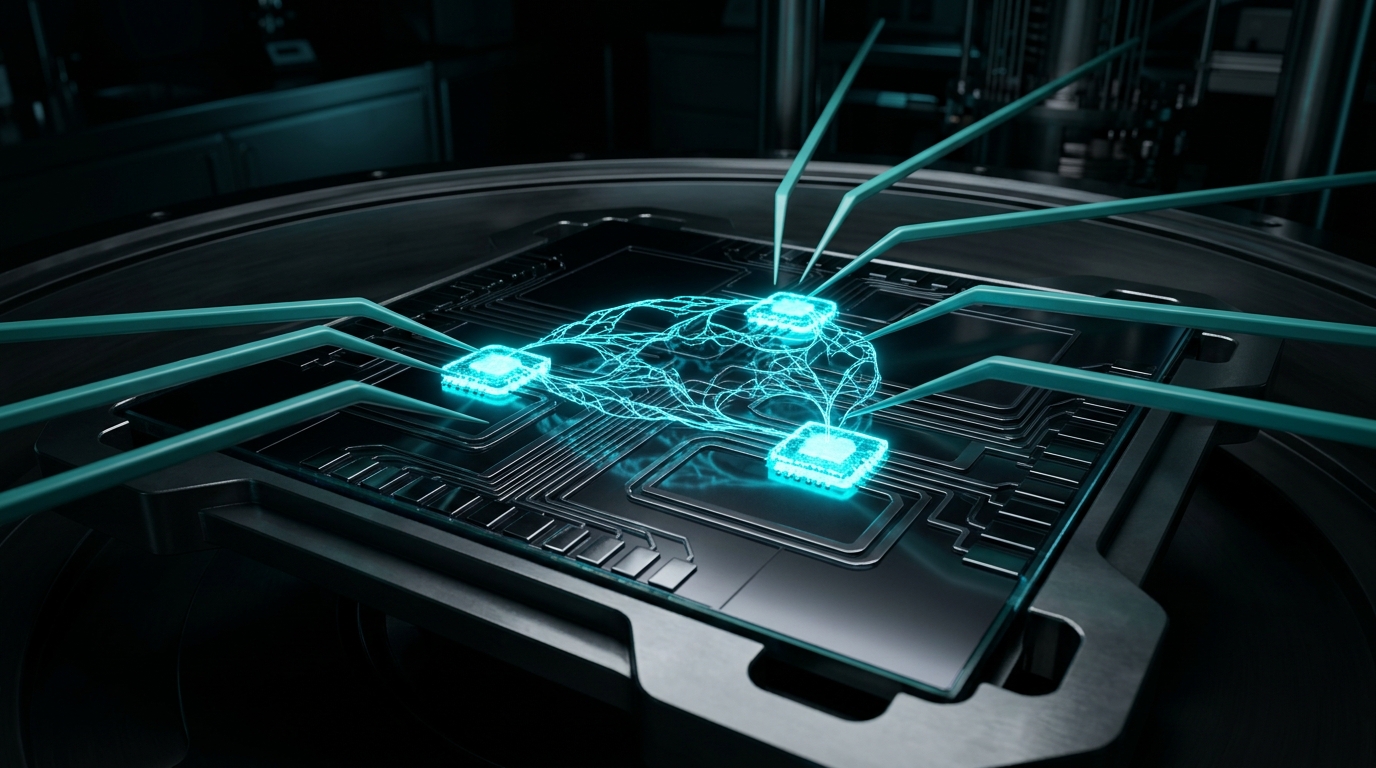
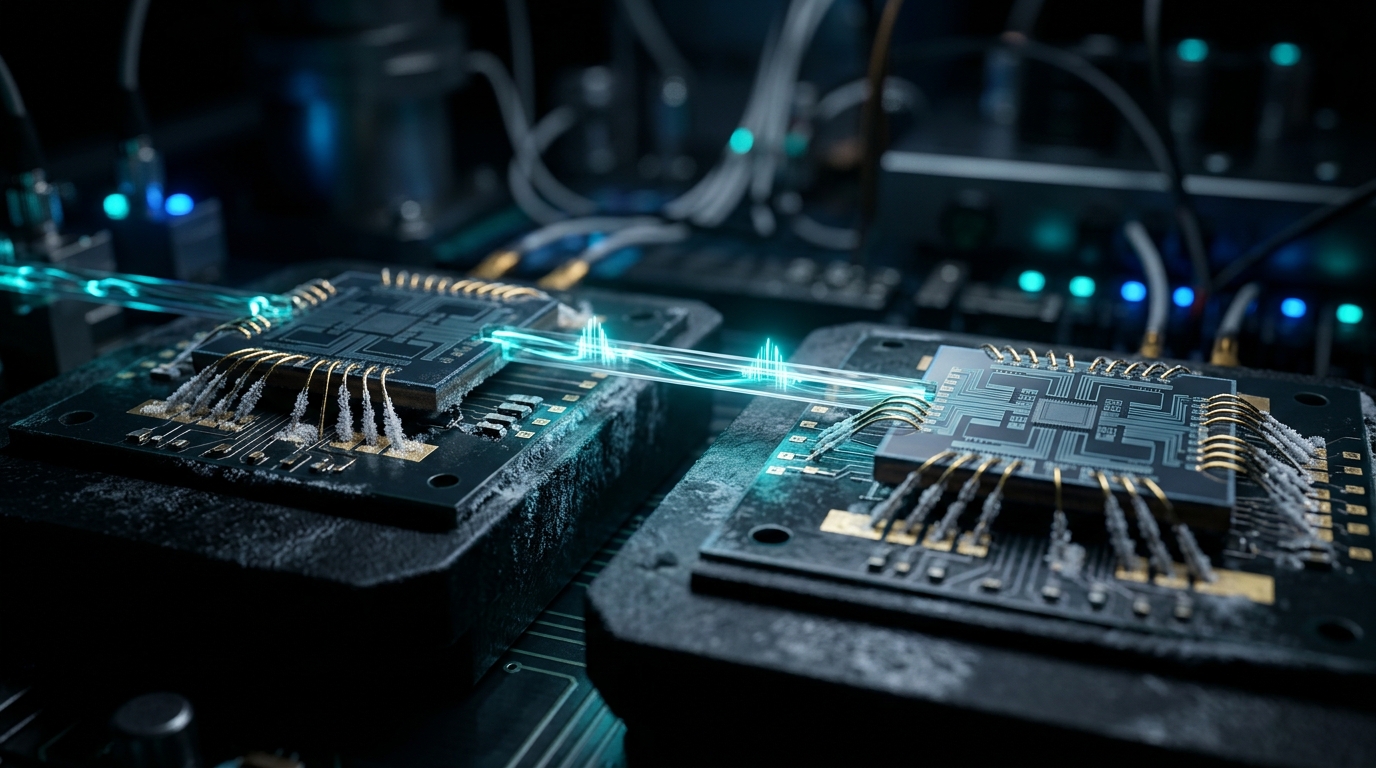
[IMAGE: FPGA circuit board connected by glowing fiber lines to a cryogenic quantum processor, syndrome data streaming between them as points of cyan light]
Why a Decoder Paper Belongs on a CISO’s Radar
Every fault-tolerant quantum computer runs a classical machine inside it. Quantum error correction continuously extracts error syndromes from physical qubits and must decode them in real time — before errors accumulate faster than they can be corrected. If the decoder falls behind, the backlog compounds and the logical computation fails. This real-time classical decoding has long been one of the most stubborn engineering bottlenecks standing between today’s noisy prototypes and a cryptographically relevant quantum computer (CRQC).
That bottleneck is why quantum error correction research is threat intelligence, not just physics news. A CRQC capable of running Shor’s algorithm against RSA-2048 or ECC P-256 doesn’t arrive because qubit counts grow — it arrives when error-corrected logical qubits become cheap enough to operate at scale. Decoders sit directly on that critical path: they must simultaneously deliver high logical accuracy and ultra-low latency, and they must do it within realistic hardware budgets.
The new work in arXiv:2606.11076 attacks both constraints at once. It introduces a coset ensemble decoder co-designed with an FPGA architecture, and reports up to an 8.2x reduction in FPGA lookup-table (LUT) consumption versus reported Union-Find decoder resources — while improving the accuracy-latency trade-off relative to both Minimum-Weight Perfect Matching (MWPM) and Union-Find (UF) baselines. When the classical control hardware for QEC gets an order of magnitude cheaper, the economics of scaling fault tolerance shift. Organizations still treating post-quantum migration as a 2035 problem should read results like this as a schedule risk indicator.
How Coset Ensemble Decoding Works
Definition: A quantum error correction decoder is the classical algorithm that takes a stream of measured error syndromes from a quantum code and infers which correction to apply. Coset ensemble decoding is a decoding strategy that explicitly exploits logically equivalent error classes (cosets): many distinct physical error patterns produce the same effect on the encoded logical information, so the decoder’s real job is to identify the most likely coset, not the most likely individual error. Aggregating probability mass across each coset approximates coset-level maximum-likelihood decoding — the theoretically optimal decision rule — at a fraction of its cost.
The two dominant practical decoders today make opposite compromises. MWPM delivers strong accuracy but carries heavy computational cost that strains real-time budgets. Union-Find runs in near-linear time and maps well to hardware, but sacrifices accuracy because it commits to a single correction without weighing logically equivalent alternatives.
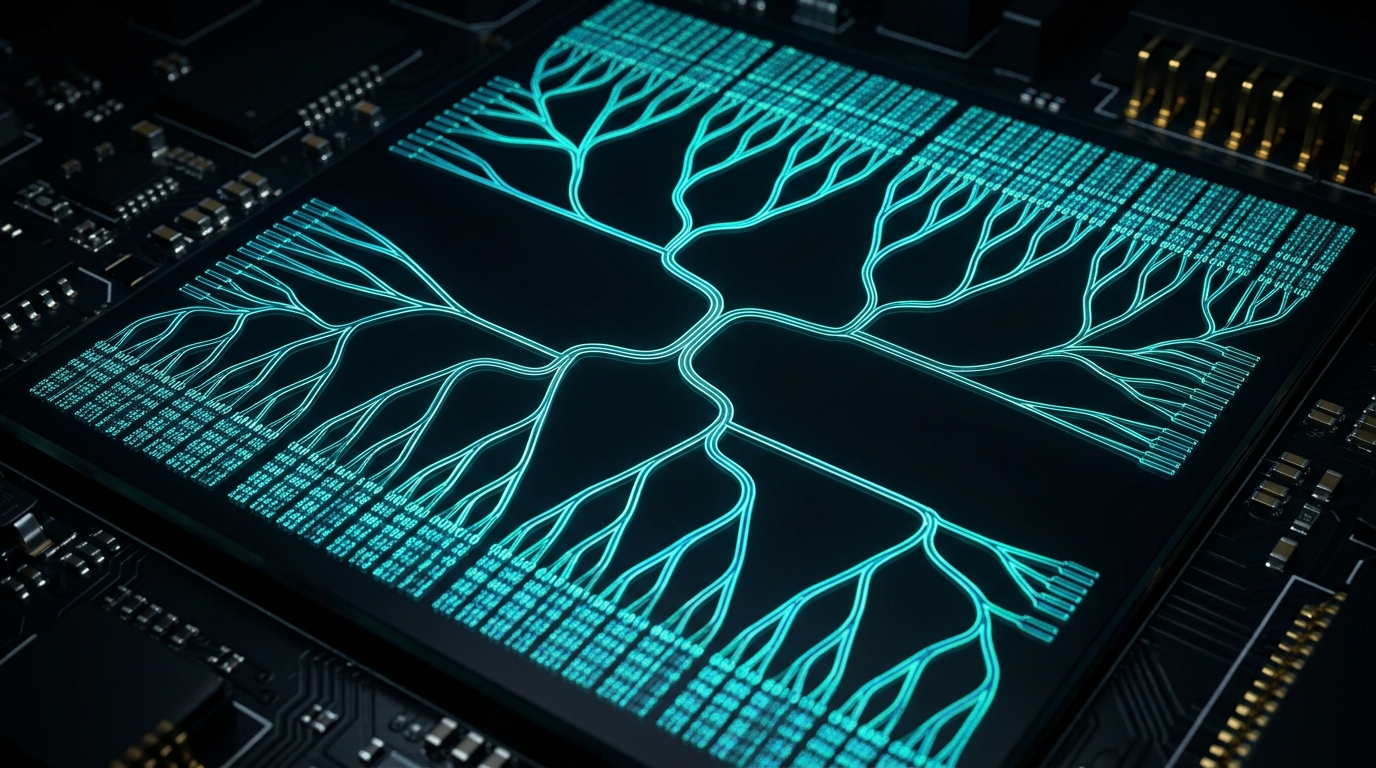
The coset ensemble approach upgrades UF rather than replacing it. The decoder performs ensemble forest exploration: it generates multiple coset-consistent candidate corrections instead of one, then aggregates the candidates to approximate coset-level maximum-likelihood decoding. Two algorithmic optimizations keep this affordable:
Reverse-Order Elimination and Graph Compression
Reverse-order elimination prunes the candidate-generation process, and lossless graph compression shrinks the syndrome graph representation. The authors report that both reduce computational and memory complexity without sacrificing accuracy — the compression is exact, not approximate. That distinction matters for anyone evaluating decoder claims: lossy shortcuts are how decoders quietly trade away the logical error rates that determine whether a quantum computation succeeds.
Temporal Resource Reuse on FPGA
Prior spatial FPGA decoder architectures dedicate hardware resources that grow in proportion to the code distance — the larger and more protective the quantum code, the more silicon you burn. The co-designed architecture instead reuses resources temporally, breaking that proportional growth. To keep the reused pipeline fed under highly concurrent access patterns, the design adds multi-bank memory hashing and hierarchical ID mapping, which mitigate pipeline stalls and memory conflicts.
“Our co-design approach achieves a better accuracy-latency trade-off than prior MWPM- and UF-based decoders, while reducing FPGA LUT consumption by up to 8.2 times compared with reported UF-based decoder resources,” the research team writes in arXiv:2606.11076.
Decoder Comparison
| Property | MWPM | Union-Find | Coset Ensemble (this work) |
|---|---|---|---|
| Decoding accuracy | High | Lower than MWPM | Better accuracy-latency trade-off than both (reported) |
| Computational cost | Heavy; strains real-time budgets | Near-linear, hardware-friendly | UF-class, plus bounded ensemble overhead |
| Coset awareness | Implicit at best | None — single candidate | Explicit — multiple coset-consistent candidates aggregated |
| FPGA resource scaling | Costly | Grows with code distance (spatial designs) | Temporal reuse; up to 8.2x lower LUT use vs. reported UF decoders |
| Tunability | Limited | Limited | Candidate count is an explicit accuracy/latency knob |
The tunable candidate number deserves emphasis. It exposes a flexible design knob: a workload running shallow circuits can run lean and fast, while a deep fault-tolerant computation — the kind needed for cryptanalysis — can spend more candidates for higher logical accuracy. One hardware design serves both regimes.
Honest caveats from the source material: the abstract reports no absolute latency figures (nanoseconds or microseconds), no specific logical error rates, no tested code distances, and no comparison against ASIC- or GPU-based decoders. Results are demonstrated under a circuit-level depolarizing noise model, which is a standard but idealized benchmark. Treat the 8.2x figure as a resource-efficiency result against reported UF implementations, pending peer review and independent reproduction. An implementation is available in the authors’ GitHub repository for teams who want to verify the claims directly.
Industry Context: Decoder Progress Compresses the PQC Clock
Regulators have already set the migration calendar. NIST finalized its first post-quantum cryptography standards — FIPS 203 (ML-KEM), FIPS 204 (ML-DSA), and FIPS 205 (SLH-DSA) — in August 2024, and NIST’s internal report IR 8547 proposes deprecating 112-bit-security classical algorithms after 2030 and disallowing RSA and ECC after 2035. The NSA’s CNSA 2.0 timeline pushes national security systems toward exclusive PQC use by 2033. Those dates were set with assumptions about how fast fault tolerance would mature.
Algorithm-hardware co-design results like this one pressure those assumptions from the engineering side. The near-term effect (1-2 years) is direct: groups building quantum computing infrastructure can adopt FPGA-based coset ensemble decoders to get better accuracy-latency trade-offs with materially less hardware. In the 3-5 year window, tunable decoder designs of this kind are positioned to become standard components in fault-tolerant architectures, enabling reliable large-scale quantum computation to spread beyond a handful of national labs. Long term, if co-design keeps compounding, the timeline to a CRQC shortens — and every year shaved off that timeline is a year removed from your migration budget.
The economic asymmetry is the part that should drive board-level urgency. Data exfiltrated today under a harvest-now-decrypt-later strategy stays compromised forever once a CRQC exists; long-lived secrets — health records, defense designs, root keys, signed firmware — are already exposed to that future. The cost of a planned, multi-year PQC migration is a known, bounded line item. The cost of retroactive compromise of a decade of intercepted traffic is not.
The BeQuantum Perspective
Our team tracks QEC decoder literature for the same reason we track factoring-algorithm improvements: both move the CRQC arrival estimate that underpins every PQC risk model. Three observations from this paper shape how we advise organizations.
First, resource efficiency is the quiet accelerant. An 8.2x LUT reduction means the classical co-processor for a given code distance fits in cheaper silicon, or a much larger code distance fits in the same FPGA. Either way, the cost-per-logical-qubit curve bends downward, and that curve — not raw qubit counts — is what we weight most heavily in the migration-urgency models behind our PQC Layer. When decoder hardware stops scaling with code distance, one of the strongest brakes on fault tolerance is released.
Second, this is why we anchor long-term integrity in hash-based and lattice-based primitives now rather than waiting for sharper CRQC forecasts. Our Digital Notary timestamps and anchors content signatures using NIST-standardized post-quantum algorithms precisely because a signature that must remain verifiable in 2040 cannot depend on assumptions a single decoder paper can erode. Organizations applying the same logic are inventorying which of their signatures, certificates, and archives carry verification lifetimes longer than the most aggressive CRQC estimate.
Third, the co-design methodology itself is the lesson. The decoder team got its gains by refusing to separate algorithm from silicon — the same discipline we apply in IceCase hardware, where PQC key storage and signing are designed against the physical device rather than ported onto it. Security architectures that treat cryptography as a software-swappable module will find migration harder than those engineered for crypto-agility from the substrate up.
What You Should Do Next
- Within 90 days, complete a cryptographic inventory with data-lifetime tagging. Catalog every TLS endpoint, code-signing key, VPN tunnel, and encrypted archive; tag each with how long its confidentiality or verifiability must hold. Anything with a >5-year lifetime protected by RSA or ECC is already inside the harvest-now-decrypt-later exposure window.
- Within 6 months, pilot hybrid key exchange (e.g., X25519 + ML-KEM-768) on one external-facing service. Major TLS stacks and CDNs already support it. The pilot’s purpose is to surface the real migration friction — handshake size, middlebox breakage, HSM support — while the stakes are low.
- Add QEC milestones to your threat-intelligence inputs. Track decoder latency/resource results and logical-qubit demonstrations alongside CVE feeds, and re-run your migration timeline whenever the cost-per-logical-qubit assumption moves — as it just did.
FAQ
Q: Does this decoder result mean quantum computers can break encryption sooner? A: Not by itself — no absolute latency or logical error rate figures are published in the abstract, and breaking RSA-2048 still requires thousands of logical qubits no machine has today. It does remove cost and scaling barriers in the real-time decoding layer, which is one of several bottlenecks that collectively determine the CRQC timeline. Each removed bottleneck shifts probability mass toward earlier arrival dates.
Q: Why do quantum error correction decoders need to run on FPGAs at all? A: QEC extracts syndrome measurements continuously, and corrections must be computed within tight real-time deadlines or errors compound faster than they can be fixed. CPUs and most GPUs introduce latency and jitter that violate those deadlines, so decoders are implemented on FPGAs or ASICs sitting close to the qubit control electronics. Resource efficiency on those devices directly limits how large a quantum code — and how reliable a logical qubit — a system can sustain.
Q: My data retention requirement is only three years. Can I deprioritize PQC migration? A: Short-lived confidentiality lowers your harvest-now-decrypt-later exposure, but signatures and firmware are different: anything you sign today that must verify in the 2030s needs quantum-resistant signatures regardless of data retention policy. NIST IR 8547’s proposed 2030/2035 deprecation dates will also pull compliance deadlines forward independent of your own risk assessment. Inventory first, then decide what can wait.