- A new method called Q-FLAIR trained a quantum model on a real IBM quantum device in four hours, surpassing 90% accuracy on the full-resolution MNIST dataset (784 features, digits 3 vs 5) — a result the authors state was previously unattainable.
- Q-FLAIR decouples quantum resource overhead from feature dimension by shifting feature and weight selection entirely onto classical computers, removing the bottleneck that made high-dimensional quantum machine learning impractical on today’s hardware.
- For security teams tracking quantum maturity, this collapses one barrier between lab demos and production-scale quantum machine learning — and it ships with a de-quantization robustness test that most quantum-advantage claims skip.
Why Quantum Machine Learning Stalled on Real Data
Most enterprise quantum machine learning (QML) experiments quietly cap their data. Researchers downsample a 28×28 MNIST image to an 8×8 grid not because the science demands it, but because the qubits can’t take it. Every classical feature you embed into a quantum feature-map costs qubits, circuit depth, or search iterations — and on noisy intermediate-scale quantum (NISQ) hardware, those budgets run out fast.
The mechanism behind the wall is specific. Quantum feature-maps embed classical data into the state space of qubits, and the dimensionality of that data drives the cost directly. As the Q-FLAIR paper puts it, feature dimension “prohibitively drives hardware demands for fixed ansätze and search costs for adaptive ansätze.” A 784-feature input — a standard, full-resolution MNIST digit — sits far beyond what fixed-circuit approaches tolerate on current devices.
This matters beyond academia. When a CISO evaluates whether quantum computing belongs on a three-year security roadmap, the honest answer has been: it can’t yet touch your real data at real resolution. Quantum kernel methods and quantum neural networks looked elegant in papers and collapsed against industry-scale feature counts. The attack surface for quantum-advantage hype was wide precisely because nobody could run the workloads that would prove or disprove the claims.
How Q-FLAIR Moves the Workload Off the Qubits
Q-FLAIR — Quantum Feature-Map Learning via Analytic Iterative Reconstructions — attacks the resource problem at its root. Instead of optimizing the quantum circuit through expensive on-hardware evaluations, it reconstructs the quantum model analytically on a classical computer using only a few quantum evaluations per step.
Definition: Q-FLAIR is an iterative feature-map construction method that builds a quantum circuit one gate at a time, but performs the costly part — selecting which data feature to encode and tuning its weight parameter — entirely on classical hardware through partial analytic reconstructions of the quantum model. The quantum device is queried only a handful of times per gate addition rather than across an exhaustive parameter sweep.
The practical consequence is the headline result. The authors report training a quantum model on a real IBM device in only four hours, surpassing 90% accuracy on full-resolution MNIST (784 features, digits 3 vs 5).
“We train a quantum model on a real IBM device in only four hours, surpassing 90% accuracy on the full-resolution MNIST dataset (784 features, digits 3 vs 5). Such results were previously unattainable.” — arXiv:2510.03389v2
Resource Overhead Decoupled From Feature Dimension
The architectural win is that overhead no longer scales with how many features your data has. For each probed gate added to the ansatz, the simultaneous selection and optimization of the data feature and its weight parameter is fully classical. The quantum hardware contributes a small, fixed number of evaluations; the classical computer absorbs the combinatorial search.
Two Integrations, Both at State of the Art
Q-FLAIR is not a single-purpose trick. The authors integrated it into two distinct QML architectures — quantum neural network classifiers and quantum kernel support vector classifiers — and report state-of-the-art benchmark performance in both. That breadth signals the method is a general feature-map learning strategy, not a one-off tuned to a single model.
| Dimension | Conventional QML feature-maps | Q-FLAIR |
|---|---|---|
| Feature/weight selection | On quantum hardware, exhaustive search | Entirely classical, analytic reconstruction |
| Quantum evaluations per gate | Many (parameter sweeps) | Only a few |
| Scaling vs. feature dimension | Hardware demand grows prohibitively | Overhead decoupled from feature dimension |
| Max demonstrated input | Typically downsampled (e.g., 8×8) | Full-resolution 784-feature MNIST |
| Real-hardware training time | Often impractical at full resolution | ~4 hours on a real IBM device |
| De-quantization tested | Rarely | Yes — robustness demonstrated |
Industry Context: A Benchmark the Field Usually Skips
The most underrated claim in the paper is not the accuracy figure — it’s the de-quantization robustness result. Q-FLAIR demonstrates robustness against direct classical modeling, which the authors frame as a necessary condition for any potential quantum advantage. In plain terms: if a classical algorithm can reproduce your quantum model’s output cheaply, your “quantum” result was never quantum in any meaningful sense.
Demonstrating de-quantization robustness is a necessary condition for credible quantum-advantage claims — a bar most QML results never test against, which is exactly why so many advantage claims evaporate under scrutiny.
This is a governance signal as much as a technical one. The quantum computing market is saturated with advantage claims that fail the moment a classical baseline is run. A method that builds the de-quantization test into its own validation raises the evidentiary standard. For security architects who will eventually have to justify quantum spend to a board, “it survives classical de-quantization” is the kind of falsifiable criterion that separates engineering from marketing.
On the regulatory and timeline front, the implication is concrete. Near-term, NISQ-era hardware can now run QML on high-dimensional, full-resolution data within practical time budgets — roughly four hours on real IBM hardware. That lowers the barrier for enterprise QML experimentation from “buy a research team and downsample everything” to “run a bounded experiment on cloud quantum hardware.” Over a three-to-five-year horizon, decoupling overhead from feature dimension is what would make quantum kernel SVMs and quantum neural networks viable on industry-scale datasets at all.
The BeQuantum Perspective
We read Q-FLAIR less as a machine-learning result and more as a maturity marker for the quantum stack our security primitives depend on. The same hardware reliability and resource-efficiency advances that let a quantum model classify MNIST in four hours are the advances that make quantum systems trustworthy enough to anchor verifiable processes.
The pattern Q-FLAIR validates — keep the quantum device doing only the irreducibly quantum work, and push everything else to classical computers — mirrors how we architect BeQuantum’s PQC Layer. Quantum and post-quantum components should be surgical, not monolithic: minimize what runs on scarce, noisy quantum resources, and let classical infrastructure carry the load it carries well. Hybrid classical-quantum partitioning is not a compromise; on NISQ hardware it is the only design that survives contact with real workloads.
The de-quantization discipline maps directly onto how our Digital Notary frames verifiable claims. A notarized attestation is only as strong as its resistance to cheaper reproduction — the cryptographic analog of de-quantization robustness. Q-FLAIR insisting that a quantum result must resist classical replication is the same instinct that should govern any security claim: state the necessary condition, then prove you meet it. We apply that standard to quantum-derived trust signals before they ever reach a customer’s compliance audit.
What You Should Do Next
- Within 90 days, separate quantum hype from quantum evidence in your vendor reviews. When a supplier claims quantum advantage in ML or security, ask one question: was it tested against classical de-quantization? Q-FLAIR shows the test is feasible. Treat its absence as a red flag, not an oversight.
- Reassess your QML feasibility assumptions if you shelved them on data-size grounds. The “quantum can’t handle our real data” objection just weakened. If you previously scoped a quantum experiment around downsampled inputs, a hybrid approach like Q-FLAIR may now bring full-resolution data into range on existing cloud quantum hardware.
- Map where hybrid classical-quantum partitioning belongs in your roadmap. The durable lesson is architectural: minimize the quantum footprint, maximize classical offload. Audit any planned quantum security or ML pilot for tasks that are sitting on quantum hardware but could run classically — that’s where time and cost budgets leak.
FAQ
Q: Does Q-FLAIR prove quantum computers now beat classical machine learning? A: No. It demonstrates a necessary condition — de-quantization robustness — not a proven advantage. The authors are careful to frame it as a concrete step toward potential genuine quantum advantage, while passing a falsifiability test that most QML results never attempt.
Q: How is four hours on real hardware significant if classical ML trains MNIST in seconds? A: The point is not speed against classical baselines. It’s that full-resolution, 784-feature data ran on a real NISQ quantum device at all, at over 90% accuracy — results the authors state were previously unattainable because feature dimension drove hardware demands beyond reach.
Q: Can I apply Q-FLAIR to datasets beyond MNIST today? A: The reported demonstration is binary classification (digits 3 vs 5), and generalization to full multi-class or other domains is untested in the source. Treat it as a validated method for high-dimensional binary feature-map learning, and scope pilots accordingly until broader results are published.
Source: “Quantum feature-map learning with reduced resource overhead,” arXiv:2510.03389v2. Last updated: 2026-06-10.
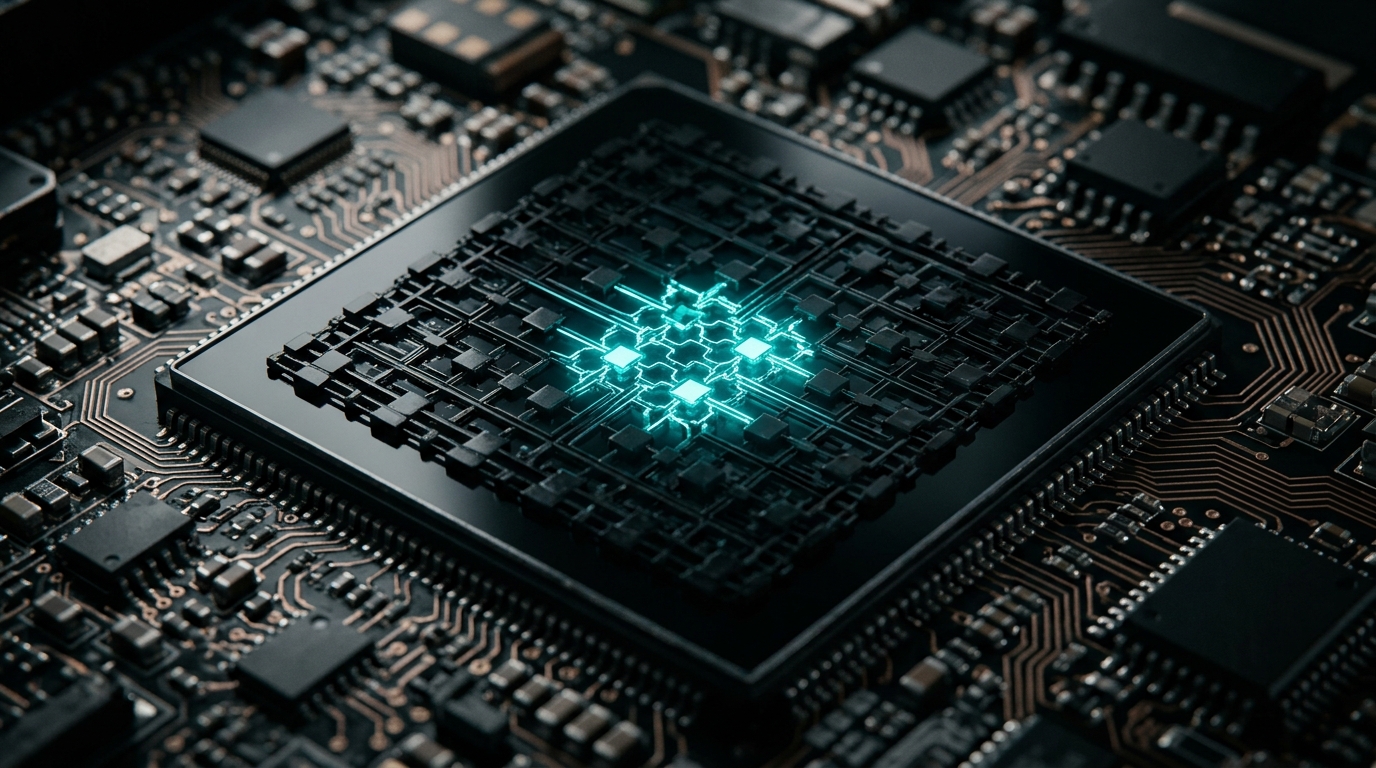
[IMAGE: macro view of an IBM-style superconducting quantum processor, with most of its qubit lattice dimmed and only a few gates glowing cyan, while a dense classical circuit board carries the surrounding computational load]