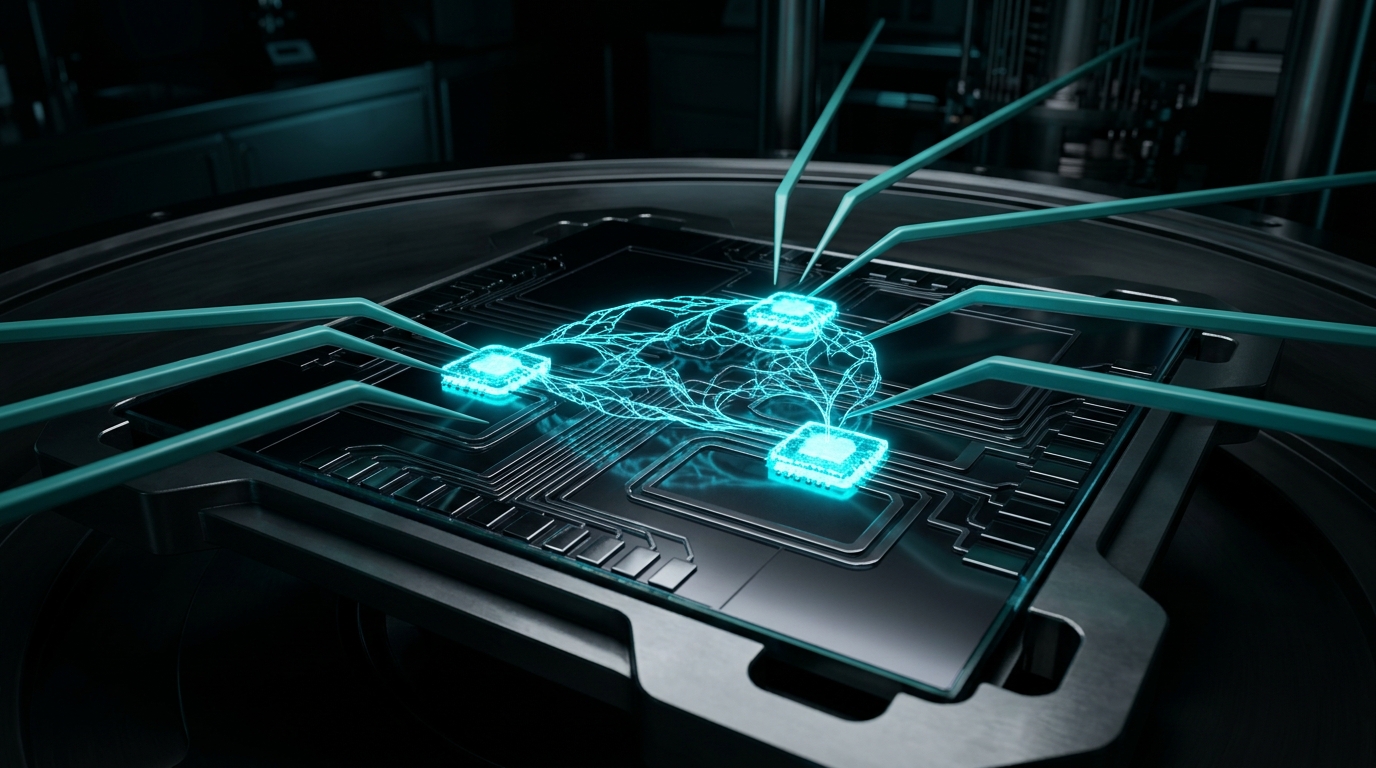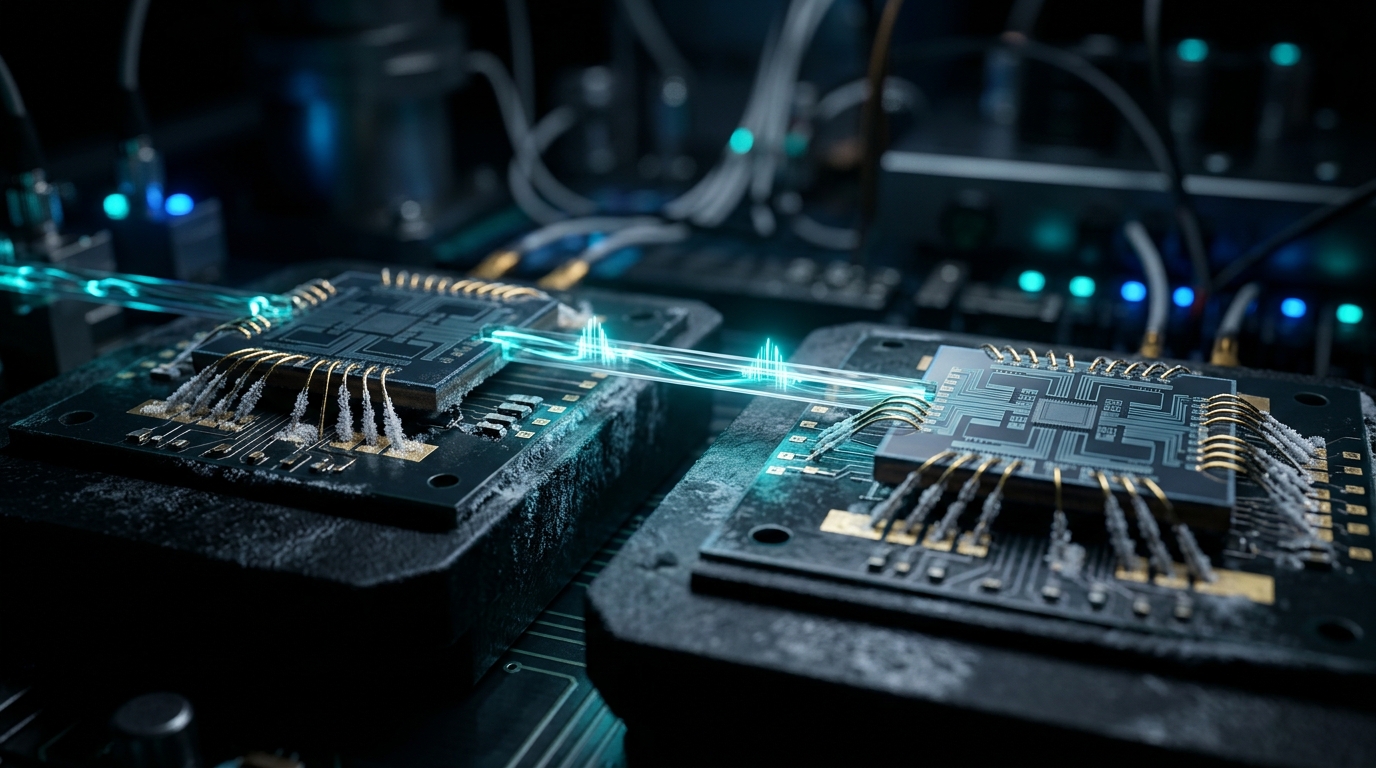
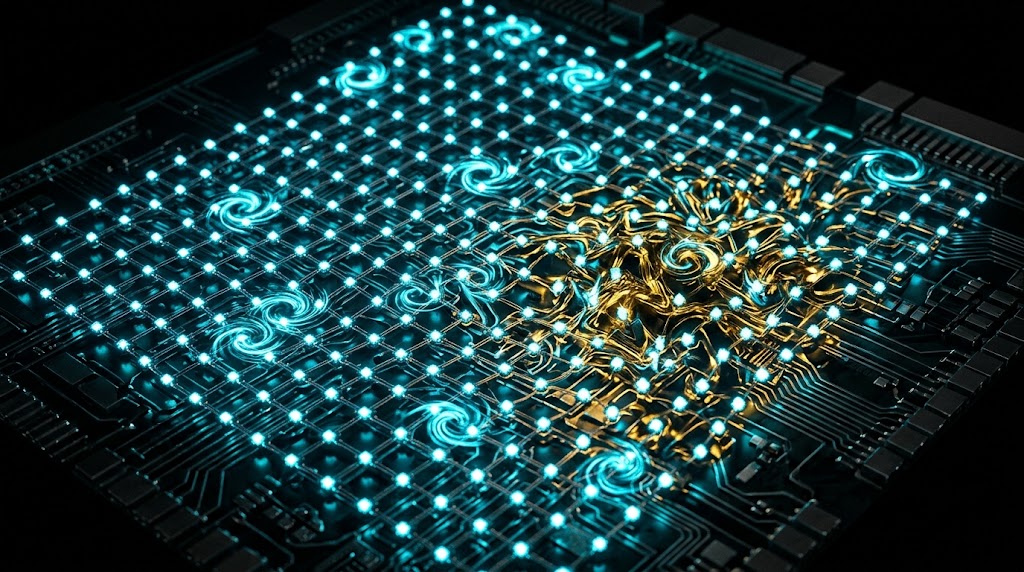
- A superconducting qubit array coupled to a shared microwave waveguide achieved programmable superradiance, with qubit–waveguide couplings engineered to be tunable in both amplitude and phase (arXiv:2605.12442).
- Strong qubit–qubit interactions stabilized superradiant and subradiant states against local dephasing, and collective decay was observed in regimes beyond the ideal Dicke model.
- What this means for you: this is foundational physics, not a security product — but it advances the control techniques behind fault-tolerant quantum computing, the trajectory that turns RSA/ECC into a dated risk and makes a PQC migration plan a present-day requirement.
Why a Quantum-Optics Paper Belongs on Your Risk Register
The paper behind this analysis never mentions cryptography, blockchain, or your attack surface. It is a many-body quantum optics experiment. So why should a security architect read past the abstract?
Because the distance between “physics lab result” and “threat to your TLS certificates” is bridged by exactly this kind of work — incremental mastery over how qubits interact, decay, and hold information. Every gain in controlling collective qubit behavior chips away at the engineering barrier separating today’s noisy prototypes from a machine that can run Shor’s algorithm at scale.
The risk is not a calendar date. It is harvest-now, decrypt-later: an adversary captures your encrypted traffic today and stores it until a sufficiently capable quantum computer exists. Any data with a confidentiality lifetime beyond roughly ten years — health records, state secrets, long-term financial instruments, biometric templates — is already exposed the moment it crosses an untrusted network. The decryption just happens later.
That reframes a physics preprint for your team. You are not tracking when quantum computers break crypto; you are tracking the rate of progress toward that point. Papers like this one are the telemetry.
Technical Deep-Dive: What the Qubit Array Actually Demonstrated
Superradiance and subradiance arise when multiple quantum emitters share a common electromagnetic environment and their emissions interfere. Constructive interference accelerates collective decay (superradiance); destructive interference suppresses it, trapping excitation in long-lived subradiant states. That interference is the whole story — and controlling it is the prize.
The textbook description is the Dicke model, which assumes identical emitters with no direct interactions. Real hardware violates both assumptions. The contribution of arXiv:2605.12442 is a platform that operates deliberately beyond the ideal Dicke regime and measures the microscopic dynamics that competing coherent interactions and collective dissipation produce — a regime the authors describe as theoretically challenging and, until now, experimentally elusive.
The engineered capabilities reported:
- Tunable coupling amplitude and phase between each qubit and the waveguide, letting the team dial in constructive or destructive interference and select the resulting super- or subradiant states.
- Site-resolved control and readout, enabling direct observation of microscopic decay dynamics across different excitation manifolds rather than only aggregate emission.
- Tracking of populations and tunable quantum correlations as multi-qubit states evolve.
The finding with the most engineering weight:
Strong qubit–qubit interactions stabilize superradiance and subradiance against local dephasing, reshaping decay pathways through spatially and spectrally structured many-body eigenstates. — arXiv:2605.12442
Dephasing — the loss of phase coherence from local noise — is a primary enemy of quantum computation. A platform where collective states resist local dephasing speaks directly to building error-resistant quantum hardware, which the authors name as their objective:
“Our results establish a flexible platform for exploring collective phenomena in many-body quantum optics and driven-dissipative approaches to robust quantum information processing.” — Abstract, Programmable Superradiance in an Interacting Qubit Array (arXiv:2605.12442)
Ideal Dicke Model vs. the Interacting-Qubit Platform
| Dimension | Ideal Dicke Model | This Platform (arXiv:2605.12442) |
|---|---|---|
| Emitter interactions | None (assumed independent) | Strong, engineered qubit–qubit interactions |
| Coupling control | Fixed, identical | Tunable amplitude and phase, per site |
| Observation | Aggregate emission | Site-resolved, microscopic decay dynamics |
| Dephasing response | Not addressed | Super-/subradiance stabilized against local dephasing |
| Operating regime | Idealized limit | Beyond the ideal Dicke model |
| Stated goal | Theoretical reference | Robust quantum information processing |
A Caveat on Specifics
Depth demands honesty about what is missing. The v1 preprint, as summarized, does not disclose the qubit count, coupling strengths, dephasing or coherence times, operating temperature, frequencies, or fidelities. There is no DOI, journal reference, or peer-review status, and author affiliations are not given in the material reviewed. Treat the qualitative claims as a credible direction of travel, not as benchmarked numbers you can drop into a roadmap.
Industry Context: The Migration Clock Is Already Running
The relevance of better quantum control is fixed by where cryptographic standards already sit.
NIST finalized its first post-quantum standards on August 13, 2024: FIPS 203 (ML-KEM, key encapsulation), FIPS 204 (ML-DSA, digital signatures), and FIPS 205 (SLH-DSA, hash-based signatures). These are not drafts. They are the migration targets your auditors will reference.
NIST’s draft guidance, IR 8547, proposes deprecating RSA-2048 and elliptic-curve cryptography around 2035, with phase-down beginning earlier. For a CISO, 2035 is close: certificate lifecycles, hardware refresh cycles, and firmware in long-lived industrial and medical equipment routinely outlast it.
This is the asymmetry that should drive budget:
| Factor | Stay on RSA/ECC | Begin PQC Migration Now |
|---|---|---|
| Harvest-now-decrypt-later exposure | Full and retroactive | Shrinks with each migrated channel |
| Compliance posture (2035 horizon) | Forced, rushed remediation | Phased, auditable transition |
| Crypto-agility | Typically low; primitives hard-coded | Built in during planned refresh |
| Cost profile | Spike under deadline plus breach risk | Amortized across normal cycles |
Subradiance carries a quieter implication. Long-lived subradiant states are a candidate mechanism for protecting quantum information — relevant to quantum memory and error protection. The same physics that could one day help build a code-breaking machine is explicitly aimed at robust quantum information processing. Progress here is dual-use, and it compresses your planning window from both directions.
The BeQuantum Perspective
The mistake we see most often is treating quantum risk as a single future event to be patched once. It is not an event; it is a moving research frontier, and results like this qubit-array experiment are how that frontier advances — through control, not through headline qubit counts.
Our architecture assumes the threat model is probabilistic and the timeline uncertain, so it optimizes for crypto-agility rather than betting on one algorithm or one breach date:
- PQC Layer implements NIST-standardized primitives (ML-KEM, ML-DSA) as swappable components, so a future change in standards or a newly weakened scheme becomes a configuration change, not a re-architecture.
- Digital Notary anchors content and transaction provenance with post-quantum signatures, so authenticity claims survive even if classical signatures become retroactively forgeable.
- IceCase hardware isolates key material, so harvested ciphertext is never paired with harvestable keys.
None of this depends on predicting when a quantum computer breaks RSA. It depends on assuming the research — including work like arXiv:2605.12442 — keeps moving.
What You Should Do Next
- Within 90 days — build a cryptographic inventory. Enumerate every system using RSA/ECC: TLS certificate chains, code-signing keys, VPNs, secrets managers, and embedded or firmware crypto. You cannot migrate what you have not mapped.
- Within 180 days — rank by confidentiality lifetime. Prioritize data that must stay secret past 2035 and systems that are hardest to update later — industrial controllers, medical devices, long-lived firmware. These are your harvest-now-decrypt-later crown jewels.
- Within 12 months — pilot a hybrid PQC deployment. Run ML-KEM in hybrid mode (classical plus post-quantum) on one high-value channel to surface performance and interoperability issues before a mandate forces the pace.
FAQ
Q: Does this superconducting qubit paper mean my encryption is now broken? A: No. The paper (arXiv:2605.12442) is a quantum-optics experiment on collective emission; it makes no cryptographic claim and demonstrates no attack. Its relevance is indirect — it advances the qubit-control techniques that, over years, push toward more capable quantum hardware.
Q: If a cryptographically relevant quantum computer is still years away, why migrate now? A: Because of harvest-now, decrypt-later. Adversaries can store your encrypted data today and decrypt it once the hardware exists. Any data with a multi-year confidentiality requirement is effectively exposed the moment it transits an untrusted network.
Q: What is the difference between superradiance and subradiance, and why should a security-adjacent reader care? A: Superradiance is accelerated collective emission from constructive interference; subradiance is suppressed emission from destructive interference, producing long-lived states. Subradiant states are of interest for protecting quantum information — the same robustness that matters for building usable, and eventually threatening, quantum computers.
Last updated: May 25, 2026. Primary source: “Programmable Superradiance in an Interacting Qubit Array,” arXiv:2605.12442, v1.