- BP decoders reduced weighted correction volume by 50.4% versus MWPM and 57.1% versus UF across 4,000 real Xanadu data slices (arXiv:2604.15389v1).
- Re-running the analysis pipeline reproduced identical SHA-256 artifacts across 108/108 fixture and 4000/4000 real request-response lines — deterministic benchmarking for QEC procurement.
- For security-sensitive quantum pilots, decoder selection is now a regime-dependent trade-off: BP for conservative paths, MWPM-family for aggressive syndrome clearing.
Why Photonic QEC Benchmarking Just Became a Procurement Problem
Enterprise security architects evaluating photonic quantum hardware face a specific blind spot: there has been no reproducible, cross-decoder contract for measuring quantum error correction (QEC) behavior on real devices. Vendors publish logical error numbers under bespoke conditions. Buyers cannot replay the runs. Procurement teams sign off on claims they cannot audit.
The LiDMaS+ paper (arXiv:2604.15389v1) addresses this directly. It defines a hardware-to-logical-to-decoder execution stack for hybrid continuous-variable (CV) and discrete-variable (DV) quantum error correction, normalizes provider-native records into a single decoder IO contract, and replays them under fixed controls across four decoder families on Xanadu hardware fixtures and sampled public datasets.
The result matters because decoder choice — not qubit count alone — now shapes the residual error budget that downstream cryptographic protocols inherit. For organizations planning post-quantum migration paths that may interact with quantum-accelerated primitives, auditable QEC performance is no longer optional.
The LiDMaS+ Architecture: A Unified Decoder IO Contract
What the stack does
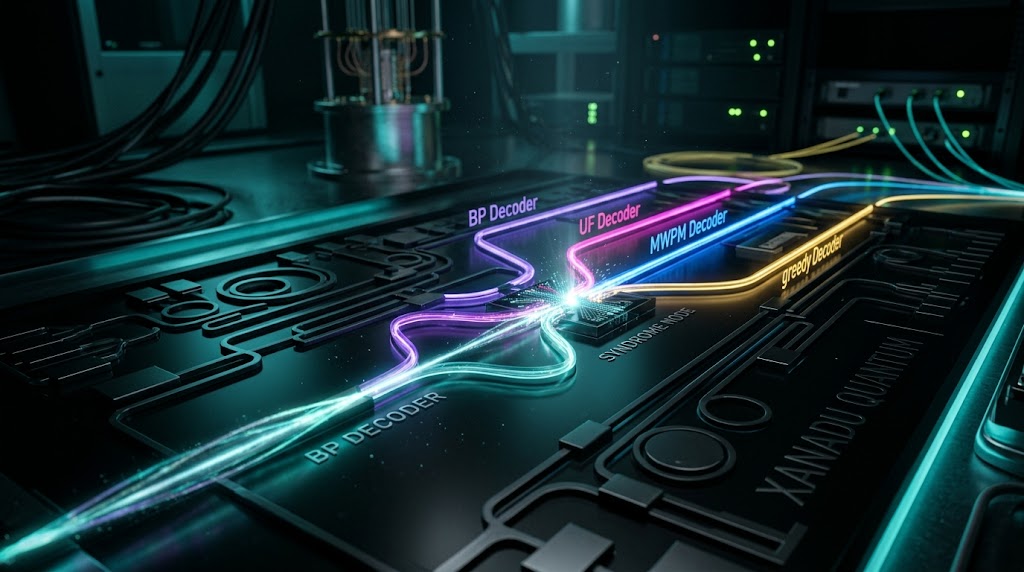
LiDMaS+ is an architecture-level execution stack that takes hybrid CV/DV quantum operations, normalizes raw provider records (Xanadu, in this study) into a canonical decoder input format, and dispatches them through interchangeable decoders under fixed controls. The decoders tested:
- MWPM — Minimum Weight Perfect Matching, the workhorse of surface-code decoding
- UF — Union-Find, a near-linear-time approximation of MWPM
- BP — Belief Propagation, a message-passing approach common in LDPC regimes
- neural-MWPM — a learned variant of MWPM
Definition: decoder IO contract
A decoder IO contract is a normalized request-response schema that abstracts away provider-specific telemetry so the same syndrome stream can be replayed identically across different decoders. LiDMaS+ enforces this contract and records every request-response pair, enabling deterministic replay.
Re-running the analysis stages reproduced identical SHA-256 artifacts across 108/108 fixture and 4000/4000 real-slice request-response lines, with zero request-parse errors, zero response-parse errors, and zero decoder-name mismatches.
That integrity property is the foundation of every number that follows.
Benchmark Results: Where the Decoders Actually Diverge
Comparison table
| Decoder | Fixture avg flip count | Real-slice avg flip count | Real nonempty-flip rate |
|---|---|---|---|
| MWPM | 1.296 | 0.641 | 0.490 |
| UF | 1.296 | 0.741 | 0.490 |
| BP | 0.667 | 0.318 | 0.318 |
| neural-MWPM | 1.296 | 0.641 | 0.490 |
Source: arXiv:2604.15389v1, weighted summaries across 108 fixture and 4,000 real request-response lines.
What the numbers mean
MWPM, UF, and neural-MWPM cluster tightly. They intervene aggressively, flipping on roughly half of real syndrome slices (0.490 nonempty-flip rate). BP behaves differently: it flips on 31.8% of slices and applies fewer flips when it does.
Across fixture data, BP reduced weighted correction volume by 48.6% versus MWPM. Across real slices, BP reduced weighted correction volume by 50.4% versus MWPM and 57.1% versus UF. (arXiv:2604.15389v1)
The trade-off the paper exposes
BP is intervention-conservative — fewer, smaller corrections. MWPM-family decoders clear more syndrome but at the cost of higher correction volume. The paper does not publish logical error rates, so which decoder yields lower end-state error remains an open empirical question. What it does publish is a reproducible contract under which that question can be asked.
The warning-no-syndrome rate — cases where the decoder flagged anomalies without matchable syndrome — is decoder-invariant and dataset-driven: 0.259 weighted on fixtures, 0.510 on real slices. That near-doubling on real data is a device-characterization signal, not a decoder-selection signal.
Industry Context: Why This Arrives at the Right Time
NIST finalized its first post-quantum cryptographic standards (ML-KEM, ML-DSA, SLH-DSA) in August 2024. Enterprises are now planning hybrid classical/PQC rollouts. In parallel, photonic quantum hardware programs — Xanadu among them — are pushing toward GKP-encoded fault-tolerant architectures that could eventually accelerate both attack and defense primitives.
For CISOs, the decision chain is concrete:
- Quantum hardware vendors pitch QEC performance figures.
- Procurement needs auditable benchmarks, not vendor slides.
- Logical error rate — the number that actually bounds cryptographic security — depends on decoder choice in ways buyers have not been able to interrogate.
LiDMaS+ supplies the audit instrument. A buyer running the contract can verify decoder behavior byte-for-byte via SHA-256 artifact equality. That is the same integrity pattern BeQuantum applies to content provenance in its Digital Notary — cryptographic reproducibility as the basis for trust.
The BeQuantum Perspective
Reproducibility is the prerequisite for security claims. In our PQC Layer work, we treat every cryptographic operation as verifiable against a fixed input contract — input hash, algorithm version, output hash — so downstream auditors can replay and compare. LiDMaS+ generalizes this pattern to quantum error correction: normalize the input, fix the controls, hash the artifact.
For organizations piloting photonic quantum hardware in security-adjacent workloads, three LiDMaS+ properties translate directly into operational practice:
- Deterministic replay allows QEC behavior to be fixed in a procurement contract, not inferred from benchmarks the vendor controls.
- Decoder interchangeability lets security teams ask regime-specific questions: does BP’s lower correction volume reduce side-channel surface in our workload, or does MWPM’s aggressive clearing better bound logical error for our threat model?
- Artifact hashing (SHA-256 across request-response streams) integrates cleanly with existing cryptographic evidence pipelines — the same primitive that underpins applies here.
The paper stops short of logical error rate comparisons. That is the next measurement our threat models need.
What You Should Do Next
- Within 90 days, add QEC reproducibility to quantum hardware RFPs. Require vendors to supply request-response artifact streams with SHA-256 digests for any published decoder benchmark. LiDMaS+ demonstrates this is achievable; treat absence as a red flag.
- Within 6 months, map your post-quantum threat model to a decoder regime. If your workload tolerates higher residual error in exchange for lower intervention volume, BP-family decoders are the evidence-backed starting point. If you need aggressive syndrome clearing, budget for MWPM-family cost.
- Within 12 months, align QEC benchmarking artifacts with your cryptographic evidence chain. The same hash-based provenance you apply to PQC signatures should extend to the quantum layer that may one day generate or consume them.
FAQ
Q: Does the LiDMaS+ paper prove BP is the best decoder for photonic quantum hardware? A: No. It proves BP intervenes less and corrects less on the Xanadu fixture and sampled public datasets tested. The paper does not publish logical error rates, latency, or threshold comparisons, so superiority claims are unsupported. The contribution is a reproducible contract, not a decoder winner.
Q: Why does this matter for post-quantum cryptography specifically? A: Logical error rate from QEC bounds the reliability of any quantum-accelerated cryptographic primitive — including future attacks on RSA/ECC and, in hybrid scenarios, defensive quantum-assisted protocols. Auditable QEC benchmarking is how enterprise security teams will eventually interrogate those reliability claims.
Q: What is the primary gap in this work that limits enterprise adoption today? A: The absence of published logical error rates, code distance parameters, and wall-clock decoder latency. Procurement cannot price decoder selection without these numbers. LiDMaS+ provides the measurement scaffolding; the measurements themselves remain to be published.