- Tenstorrent’s QuietBox 2 packs 384 GB of memory across four custom Blackhole accelerators, running Meta’s Llama 3.1 70B at nearly 500 tokens per second — all within a 1,400 W power envelope
- Matching the QuietBox 2’s 128 GB GDDR6 capacity would require four Nvidia RTX 5090 GPUs drawing an estimated 4,000 W+ at load — physically impossible in standard workstation form factors
- For security-conscious enterprises, sub-$10,000 local inference hardware eliminates the largest AI adoption blocker: sending sensitive data to third-party cloud endpoints
The Data Exfiltration Problem No One Wants to Talk About
Every enterprise AI deployment built on cloud APIs creates a data pipeline that security teams cannot fully control. When a financial analyst queries GPT-5.2 about merger scenarios, or a legal team runs contract analysis through Claude 4.6, sensitive organizational data traverses networks, lands on third-party servers, and enters logging systems governed by someone else’s retention policies.
This isn’t theoretical risk. It’s the reason 47% of enterprises surveyed in 2025 restricted or banned generative AI tools outright, according to Cisco’s Data Privacy Benchmark Study. The alternative — running large language models on-premises — has required data-center-grade infrastructure costing hundreds of thousands of dollars.
That constraint just broke.
What Tenstorrent’s QuietBox 2 Actually Delivers
Tenstorrent, the AI chip company co-founded by legendary processor architect Jim Keller, announced the QuietBox 2 — a desktop-class AI workstation targeting Q2 2026 at a US $9,999 price point. The hardware specifications matter for security architects evaluating local inference options.
Definition: The QuietBox 2 is a purpose-built AI inference workstation containing four Tenstorrent Blackhole custom AI accelerators with 128 GB of GDDR6 memory and 256 GB of DDR5 system memory (384 GB total), designed to run large language models locally without cloud connectivity.
The performance claims are specific: Meta’s Llama 3.1 70B runs at nearly 500 tokens per second. The system can load OpenAI’s open-weight GPT-OSS-120B model entirely in local memory. Milos Trajkovic, cofounder and systems engineer at Tenstorrent, framed the competitive positioning directly:
“Our 128 gigabytes of GDDR6 RAM would require four Nvidia RTX 5090 graphics cards. That couldn’t fit in today’s 1,600-watt form factor, and the cost for four RTX 5090 GPUs is huge.” — Milos Trajkovic, cofounder and systems engineer at Tenstorrent
The power math validates his claim. Nvidia recommends 1,000 W system power for a single RTX 5090. A dual-GPU setup already exceeds the continuous draw rating for a typical 15-ampere, 120-volt office circuit. Four RTX 5090s at load could demand 4,000 W or more — requiring dedicated electrical infrastructure. The QuietBox 2 draws 1,400 W at full load, fitting within standard office power constraints.
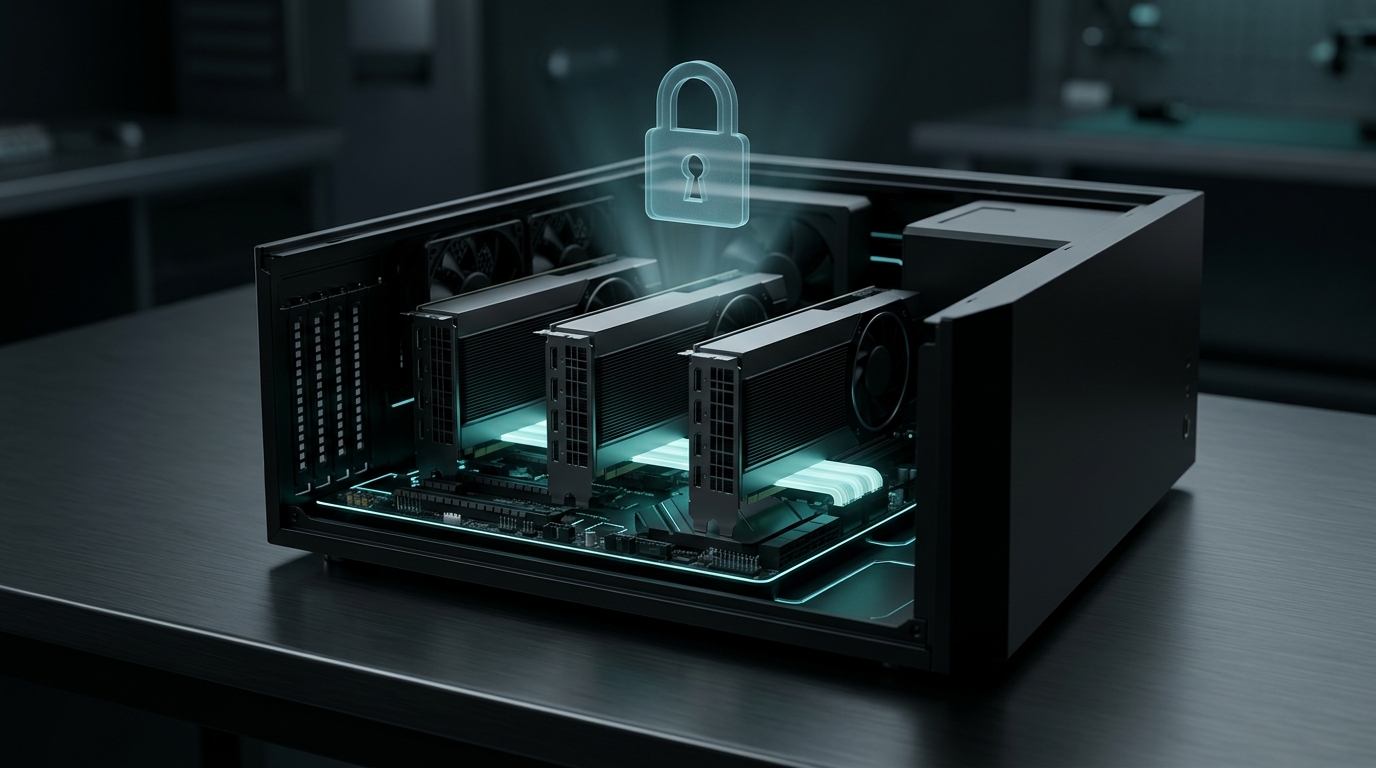
[IMAGE: A matte-black desktop workstation with subtle ventilation grilles sits on a dark desk, its side panel revealing four glowing AI accelerator cards connected by high-bandwidth links, with faint cyan light tracing the memory bus architecture — macro photography angle, cinematic lighting, 8K quality]
The Memory Ceiling Problem
Model size determines what hardware can run which AI workloads. The current landscape breaks down sharply:
| Hardware Tier | Memory Capacity | Maximum Model Size | Typical Cost | Power Draw |
|---|---|---|---|---|
| Consumer laptop | 8–16 GB unified | 8B–13B parameters | $1,500–3,000 | 65–100 W |
| High-end workstation (single GPU) | 24–32 GB VRAM | ~30B parameters | $3,000–5,000 | 500–800 W |
| Dual RTX 5090 workstation | 64 GB VRAM | ~70B parameters | $8,000–12,000 | 2,000+ W |
| Tenstorrent QuietBox 2 | 128 GB GDDR6 + 256 GB DDR5 | 120B+ parameters | $9,999 | 1,400 W |
| Cloud API (GPT-5.2, Claude 4.6) | Provider-managed | 1T+ parameters (estimated) | Per-token pricing | N/A (client-side) |
The QuietBox 2 occupies a gap that didn’t previously exist: 120B-parameter local inference at workstation pricing and power requirements. For security teams, this gap is where the most consequential architectural decisions live.
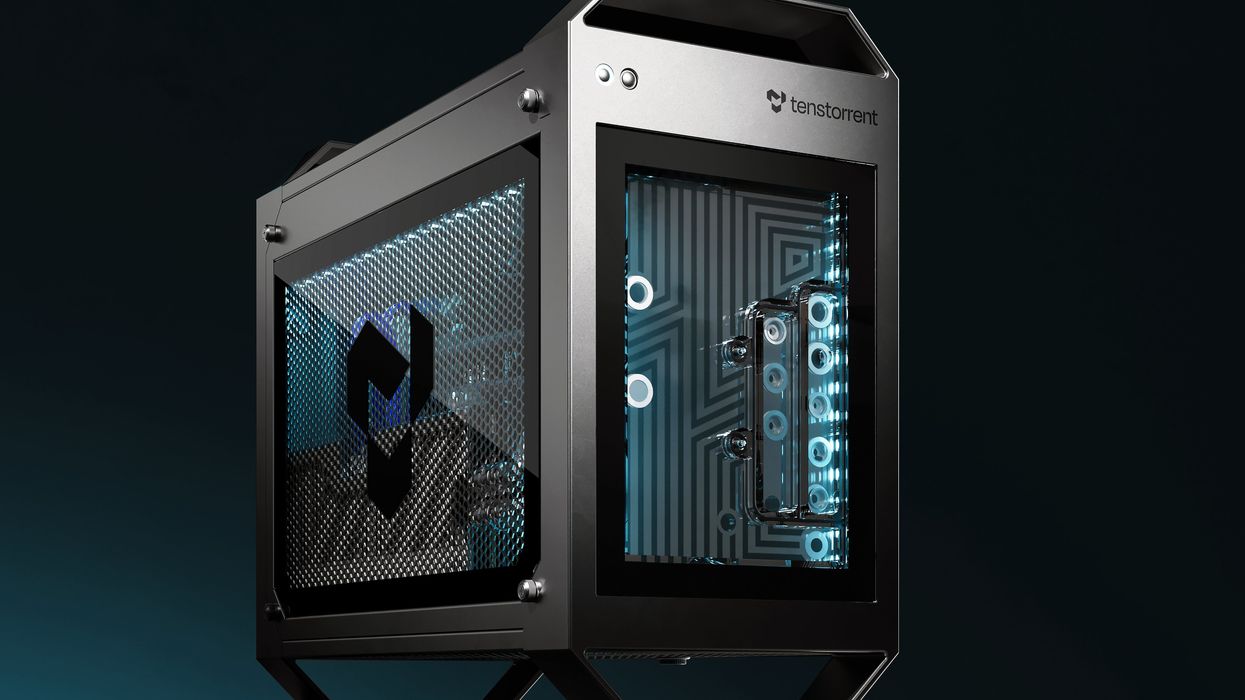 Image source: spectrum.ieee.org
Why Security Architects Should Pay Attention
Air-Gapped AI Becomes Feasible
Organizations handling classified data, HIPAA-protected health records, or financial trading strategies have largely been locked out of large-model AI. The models capable enough to provide genuine analytical value (70B+ parameters) required cloud inference. Cloud inference required network connectivity. Network connectivity violated data handling policies.
A $10,000 workstation that runs 120B-parameter models changes this calculus entirely. Defense contractors, healthcare systems, and financial institutions can deploy capable AI assistants that never connect to external networks. The data stays on hardware the organization owns, in rooms the organization controls, governed by policies the organization writes.
The Inference Speed Security Trade-off Disappears
Tenstorrent claims the QuietBox 2’s inference speed is “several times quicker than an average response from GPT-5.2 or Claude 4.6.” This comparison conflates local hardware throughput with cloud API latency — network round trips, queue wait times, and rate limiting all inflate cloud response times beyond raw compute speed. But for the enterprise security buyer, the distinction is irrelevant. What matters is that local inference no longer imposes a productivity penalty severe enough to drive employees toward unauthorized cloud AI tools.
Shadow AI — employees using personal ChatGPT accounts because approved tools are too slow or too restricted — represents one of the fastest-growing attack surface expansion vectors in enterprise security. Hardware that makes sanctioned local AI faster than unsanctioned cloud AI eliminates the incentive for policy violations.
For security teams, the QuietBox 2’s most important specification isn’t its 500 tokens-per-second throughput — it’s the zero bytes per second of sensitive data leaving the network perimeter.
What the Benchmarks Don’t Tell You
Several critical gaps remain in Tenstorrent’s public disclosures that security architects should evaluate before procurement:
- Quantization levels undisclosed: The 500 tokens/second benchmark on Llama 3.1 70B likely uses quantized model weights (4-bit or 8-bit). Full-precision inference would be significantly slower. For security applications where model accuracy directly affects threat detection, quantization trade-offs matter.
- Software ecosystem unknown: No details on supported frameworks, ONNX compatibility, or integration with enterprise ML platforms like MLflow or Kubeflow. A hardware accelerator without a mature software stack creates deployment friction.
- No training capability mentioned: All benchmarks are inference-only. Organizations needing to fine-tune models on proprietary data may still require cloud or data-center GPU infrastructure.
- Supply chain readiness unclear: Q2 2026 launch with no disclosed production capacity data. Enterprise procurement cycles require supply chain confidence.
The Market Context: Nvidia’s Grip Loosens
Tenstorrent isn’t the only company targeting Nvidia’s dominance, but the QuietBox 2 attacks a specific vulnerability: Nvidia’s architecture optimizes for data-center-scale training, not power-efficient desktop inference. The RTX 5090’s 1,000 W recommended system power reflects a design philosophy that prioritizes peak throughput over deployability.
For the near term (2026–2027), enterprises gain a concrete alternative for on-premises inference workloads under 120B parameters. The medium-term implication (2028–2030) is more significant: if custom AI accelerators from Tenstorrent and competitors deliver competitive memory-per-watt and tokens-per-dollar, the default enterprise AI architecture shifts from cloud-first to hybrid. Security teams that plan infrastructure around cloud API dependency may find themselves retrofitting architectures that should have been local from the start.
The long-term trajectory points toward AI inference becoming standard endpoint computing — as routine as running a web browser. When every analyst workstation can run a 70B-parameter model locally, the security perimeter for AI-processed data contracts from “the entire internet” to “this building.”
The BeQuantum Perspective: Local Inference Meets Verifiable Integrity
Local AI inference solves the data exfiltration problem but introduces a new one: how do you verify that a locally-run model hasn’t been tampered with, that its outputs haven’t been modified, and that the inference pipeline maintains cryptographic integrity from input to output?
This is precisely where BeQuantum’s architecture intersects with hardware like the QuietBox 2. Our Digital Notary framework provides cryptographic attestation for AI-generated content — timestamped, hash-verified provenance chains that prove which model produced which output, on which hardware, at which time. When inference moves from a cloud provider’s audited infrastructure to a desktop workstation, the burden of proving output integrity shifts to the organization. Post-quantum cryptographic signatures ensure those attestation chains remain trustworthy even against future quantum-capable adversaries.
The combination of local inference hardware and cryptographic content verification creates an architecture where sensitive data never leaves the premises AND every AI-generated output carries mathematically verifiable provenance. For regulated industries facing both data privacy mandates and AI transparency requirements, this dual capability isn’t optional — it’s the minimum viable compliance posture.
What You Should Do Next
-
Within 30 days — Audit your AI data flows. Map every instance where organizational data reaches a cloud AI endpoint. Classify each flow by sensitivity level and regulatory exposure. This inventory becomes your prioritization framework for local inference migration.
-
Within 90 days — Evaluate local inference hardware options. The QuietBox 2 ships Q2 2026, but benchmark it against AMD Instinct MI300X workstations and Intel Gaudi 3 configurations. Your evaluation criteria should weight memory capacity, power requirements, software ecosystem maturity, and cryptographic attestation support equally.
-
Within 180 days — Pilot a hybrid AI architecture. Run privacy-sensitive workloads on local inference hardware while maintaining cloud API access for non-sensitive tasks. Implement cryptographic provenance tracking for all AI-generated outputs regardless of where inference occurs.
Frequently Asked Questions
Q: Can the QuietBox 2 replace cloud AI services like GPT-5.2 or Claude 4.6 entirely?
A: Not for all workloads. The QuietBox 2 handles models up to approximately 120 billion parameters. Frontier cloud models are estimated to exceed one trillion parameters, delivering capabilities that local hardware cannot yet match. The security advantage lies in routing sensitive workloads to local inference while using cloud APIs for non-sensitive tasks requiring maximum model capability.
Q: How does local AI inference affect compliance with data residency regulations like GDPR and CCPA?
A: Local inference eliminates cross-border data transfer concerns entirely for AI processing workloads. When model inference runs on hardware within your jurisdiction, the processed data never enters a third-party system or crosses a national boundary. This simplifies compliance documentation and removes the need for data processing agreements with AI cloud providers for those specific workloads.
Q: What security risks does local AI hardware introduce that cloud AI doesn’t have?
A: Physical security becomes critical — a stolen workstation with loaded model weights and cached inference data represents a concentrated data breach target. Organizations must also manage model integrity verification (ensuring weights haven’t been poisoned), firmware security for the AI accelerators themselves, and access controls equivalent to what cloud providers maintain. These are solvable problems, but they require deliberate security architecture rather than inherited cloud provider controls.
Last updated: April 6, 2026
Sources: IEEE Spectrum — “These AI Workstations Look Like PCs but Pack a Stronger Punch”