
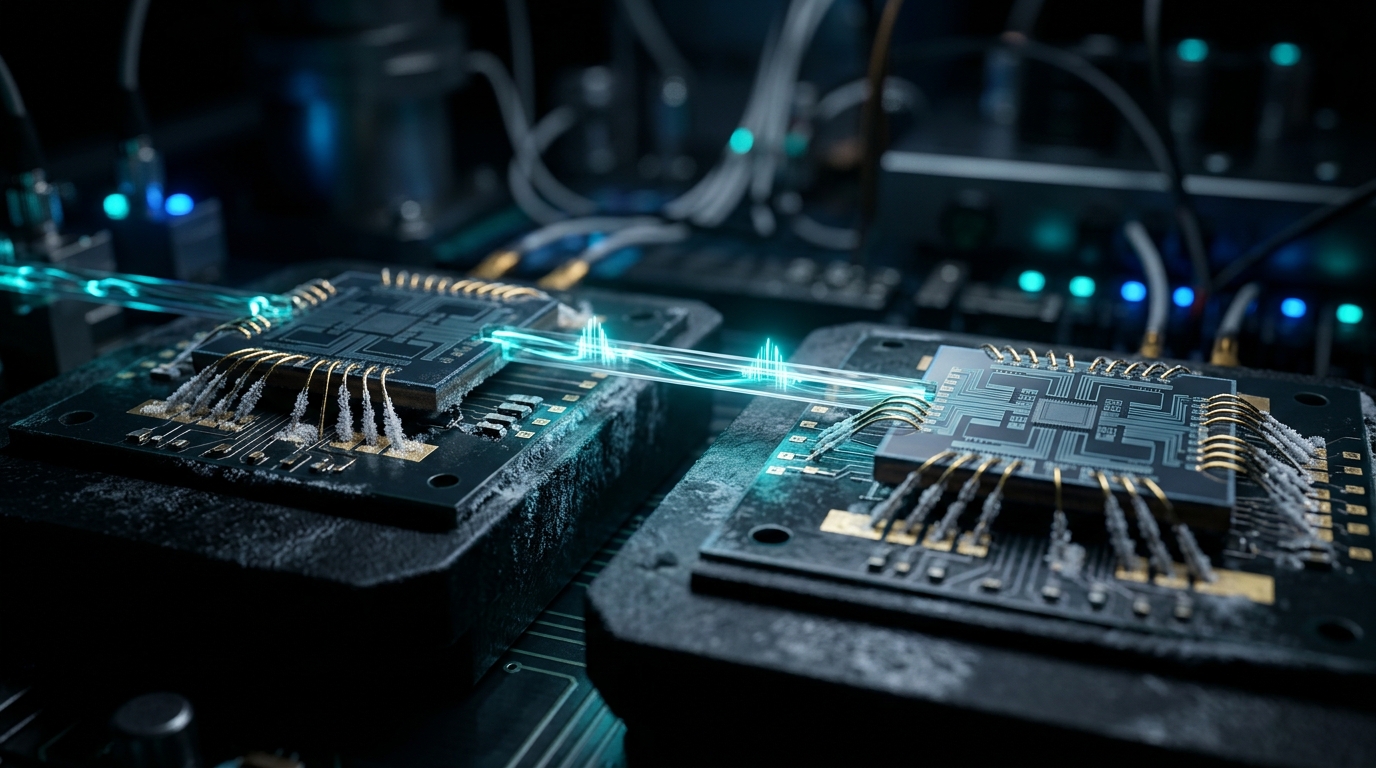
- A proposed long-range tunable coupler connects fluxonium qubits across more than one centimeter with intrinsic gate errors below 10⁻⁴ — potentially matching on-chip gate performance for the first time
- Sub-100-nanosecond two-qubit gate times in a modular chiplet architecture could accelerate the path to cryptographically relevant quantum computers by years
- Security teams should treat modular quantum scaling breakthroughs as threat-model inputs, not distant research curiosities
Why Modular Quantum Scaling Changes Your Threat Timeline
Every enterprise risk model for post-quantum migration assumes a timeline. That timeline rests on one bottleneck above all others: how fast quantum hardware can scale from hundreds of noisy qubits to the millions of error-corrected qubits needed to break RSA-2048 and ECDH.
Monolithic quantum chips — single slabs of silicon or sapphire packed with qubits — hit a hard ceiling. Fabrication defects scale with chip area. Crosstalk grows as qubits crowd together. Yield collapses. The industry consensus has shifted toward modular architectures: smaller chiplets linked by inter-module connections, much like classical multi-die processors.
The problem? Connecting qubits across separate modules has historically meant slower gates, higher error rates, and crosstalk that destroys the very coherence you need for error correction. A new theoretical design published on arXiv (arXiv:2604.12261) proposes a long-range tunable coupler for fluxonium qubits that, if validated experimentally, could eliminate that penalty entirely.
For CISOs planning post-quantum cryptography (PQC) migration timelines, this is a concrete data point: the scaling bottleneck just got a credible engineering workaround.
What Fluxonium Qubits Are and Why They Matter for Scaling
Fluxonium qubits are superconducting quantum bits that use a superinductor — a chain of Josephson junctions — to achieve longer coherence times and higher gate fidelities than the more common transmon qubit design used by IBM and Google. Where transmons trade simplicity for limited anharmonicity (making it harder to avoid leakage to unwanted energy levels), fluxonium qubits offer stronger anharmonicity and naturally longer energy relaxation times.
The tradeoff: fluxonium qubits are harder to couple over distance. Existing coupling schemes work only for qubits in close proximity on a single chip. This constraint has kept fluxonium architectures locked into monolithic designs, limiting their scalability advantage despite superior per-qubit performance.
The arXiv preprint (2604.12261v1) directly attacks this limitation.
| Parameter | Transmon (Typical) | Fluxonium (Typical) | Proposed Modular Fluxonium |
|---|---|---|---|
| Qubit type | Superconducting | Superconducting | Superconducting |
| Anharmonicity | ~200-300 MHz | ~1-5 GHz | ~1-5 GHz |
| Coupling range | On-chip (mm scale) | On-chip (mm scale) | Cross-module (>1 cm) |
| Two-qubit gate time | ~20-60 ns | ~60-200 ns | <100 ns (theoretical) |
| Intrinsic gate error | ~10⁻³ to 10⁻² | ~10⁻⁴ to 10⁻³ | <10⁻⁴ (theoretical) |
| Architecture | Monolithic / modular | Monolithic only | Modular chiplet |
Table: Comparison of qubit architectures. Proposed modular fluxonium values are theoretical targets, not experimental measurements.
[IMAGE: A close-up view of two separated superconducting quantum processor chiplets connected by a luminous long-range coupler waveguide spanning more than a centimeter, rendered with deep blue and cyan tones]
Technical Deep-Dive: The Long-Range Tunable Coupler
How It Works
The proposed coupler creates a tunable interaction between two fluxonium qubits located on physically separated modules — chiplets — more than one centimeter apart. The design uses a mediating coupler element whose frequency can be adjusted to turn the qubit-qubit interaction on and off, enabling fast entangling gates while maintaining isolation during idle periods.
Three performance targets define the design:
- Gate speed: Sub-100-nanosecond two-qubit gates, fast enough to complete operations before decoherence degrades the quantum state
- Gate fidelity: Intrinsic error rates below 10⁻⁴ (less than 0.01%), matching the best on-chip fluxonium gates demonstrated to date
- Low crosstalk: Modular integration with minimal quantum crosstalk between modules, a prerequisite for implementing quantum error correction across chiplet boundaries
“Under realistic assumptions, the proposed coupler has the potential to achieve inter-module two-qubit gate performance, specifically sub-100-ns gates with intrinsic errors below 10⁻⁴, comparable to that of intra-module (intra-chiplet) gates, while enabling modular integration with low quantum crosstalk, a key requirement for scalable systems.” — arXiv:2604.12261
What “Comparable to Intra-Module” Actually Means
This is the critical claim. In every modular quantum architecture proposed to date — whether using microwave interconnects, photonic links, or ion shuttling — the inter-module connection is the weak link. Gates across modules are slower, noisier, and introduce additional decoherence channels.
If a coupler can genuinely deliver inter-module performance on par with intra-module gates, it removes the primary architectural penalty of going modular. Quantum error correction codes, which require high-fidelity operations across the entire qubit lattice, would no longer need to treat module boundaries as fault zones requiring special handling.
For scaling projections, this matters enormously. A modular architecture with no inter-module penalty scales like a monolithic chip — but without the fabrication yield limits.
Critical Caveat: Theory, Not Experiment
Every performance claim in this preprint comes from theoretical analysis under what the authors describe as “realistic assumptions.” No experimental demonstration exists. No fabrication has been attempted. No measured coherence times, no real crosstalk characterization, no yield data.
This distinction is essential for threat modeling. A theoretical design with sub-10⁻⁴ error rates is a credible engineering target, not a demonstrated capability. The gap between simulation and silicon has historically taken 3-7 years to close in superconducting qubit research.
Security architects should factor this into migration timelines as a risk accelerator, not a confirmed capability.
Industry Context: The Modular Quantum Race
Where This Fits in the Hardware Landscape
The quantum computing industry has converged on modularity as the path to scale. IBM’s roadmap features multi-chip “Heron” processors with classical interconnects. Google has pursued monolithic scaling with its Willow chip but faces yield constraints. Startups like Alice & Bob and Nord Quantique are exploring alternative qubit modalities with built-in error protection.
Fluxonium-based architectures have remained a research-stage alternative, championed by academic groups for their superior coherence properties but lacking a clear scaling pathway. This coupler design, if validated, provides that missing pathway.
Regulatory and Compliance Pressure
NIST finalized its first post-quantum cryptographic standards (FIPS 203, 204, and 205) in August 2024, with mandatory federal adoption timelines extending through 2035. The National Security Memorandum NSM-10 requires federal agencies to inventory cryptographic systems and prioritize migration.
The underlying assumption: large-scale fault-tolerant quantum computers remain at least a decade away. Every credible scaling advance — including theoretical ones — compresses that assumption. Organizations relying on the “we have time” argument need to stress-test it against papers like this one.
Economic Calculus
The cost of post-quantum migration rises with delay. Cryptographic agility — the ability to swap algorithms without redesigning systems — is cheapest to implement during scheduled infrastructure refreshes. Organizations that wait for experimental confirmation of modular quantum scaling will face compressed timelines and higher migration costs.
Conversely, premature migration carries its own costs: PQC algorithms have larger key sizes, higher computational overhead, and less operational maturity than classical alternatives. The optimal strategy is preparation without premature deployment: inventory, test, architect for agility, and monitor hardware advances.
The BeQuantum Perspective
BeQuantum’s approach to post-quantum readiness treats quantum hardware advances as intelligence inputs, not abstract research. Our Digital Notary platform timestamps and cryptographically signs content using PQC-ready algorithms precisely because the timeline for quantum threats is uncertain and compressing.
The fluxonium coupler design illustrates why harvest-now-decrypt-later attacks demand attention today. Data encrypted with classical algorithms and exfiltrated now could become readable if modular quantum architectures close the scaling gap within five to seven years. BeQuantum’s PQC Layer addresses this by enabling organizations to apply quantum-resistant signatures to data at rest and in transit without waiting for full infrastructure migration.
For organizations evaluating their quantum risk exposure, the key question is not whether this specific coupler will reach production — it is whether your cryptographic architecture can absorb the surprise if it does.
What You Should Do Next
Within 30 days: Complete a cryptographic asset inventory. Identify every system using RSA, ECDH, or ECDSA for key exchange or digital signatures. Prioritize assets with data retention periods exceeding 10 years — these face the highest harvest-now-decrypt-later exposure.
Within 90 days: Test PQC algorithm compatibility in your TLS certificate chain. Deploy ML-KEM (FIPS 203) in a staging environment and measure latency impact on your most performance-sensitive services. Document the results as a migration readiness baseline.
Within 180 days: Architect cryptographic agility into your next infrastructure refresh cycle. Ensure key management systems, certificate authorities, and VPN gateways can support algorithm substitution without application-layer changes. Treat this as an operational capability, not a one-time project.
Frequently Asked Questions
Q: Does this fluxonium coupler mean quantum computers can break encryption sooner?
A: Not directly. This is a theoretical design, not a working device. However, it provides a credible engineering path to scale fluxonium-based quantum processors beyond single-chip limits. If experimentally validated, it could compress the timeline to large-scale fault-tolerant quantum computing by reducing the primary architectural bottleneck — inter-module gate quality. Security teams should treat it as a data point that tightens uncertainty ranges in threat models, not as an immediate capability change.
Q: Why should CISOs care about a preprint with no experimental data?
A: Because migration timelines measured in years must be planned against threat timelines measured in years. By the time a coupler design moves from theory to fabrication to integration, organizations that waited for experimental proof will face compressed migration windows and elevated costs. The value of early theoretical signals is planning time — and planning time is the scarcest resource in PQC migration.
Q: How does modular quantum architecture compare to monolithic scaling?
A: Monolithic architectures fabricate all qubits on a single chip, which limits scale due to yield and crosstalk constraints. Modular architectures partition qubits across separate chiplets connected by inter-module links. The historical penalty — slower, noisier inter-module gates — has made modular approaches less attractive. This coupler design claims to eliminate that penalty for fluxonium qubits, which would make modular scaling competitive with monolithic approaches while bypassing their fabrication limits.
Last updated: April 17, 2026. Source: arXiv:2604.12261v1 (preprint, not peer-reviewed). All performance figures represent theoretical projections under simulated conditions, not experimental measurements.