Last updated: June 2025
Key Takeaways
- Researchers demonstrated 99.87% single-qubit gate fidelity and 97.5% controlled-Z gate fidelity in a 3-layer vertically stacked superconducting processor — metrics that approach fault-tolerance thresholds for cryptographically relevant computation
- Vertical tunable couplers enable both intrachip and interchip entanglement at equivalent fidelity, removing the primary physical constraint that has kept superconducting qubit counts low
- If 3D stacking compresses the fault-tolerant quantum computing timeline by even 18 months, organizations still running RSA-2048 or ECDH key exchange face a materially shorter window to complete PQC migration than NIST’s published guidance assumes
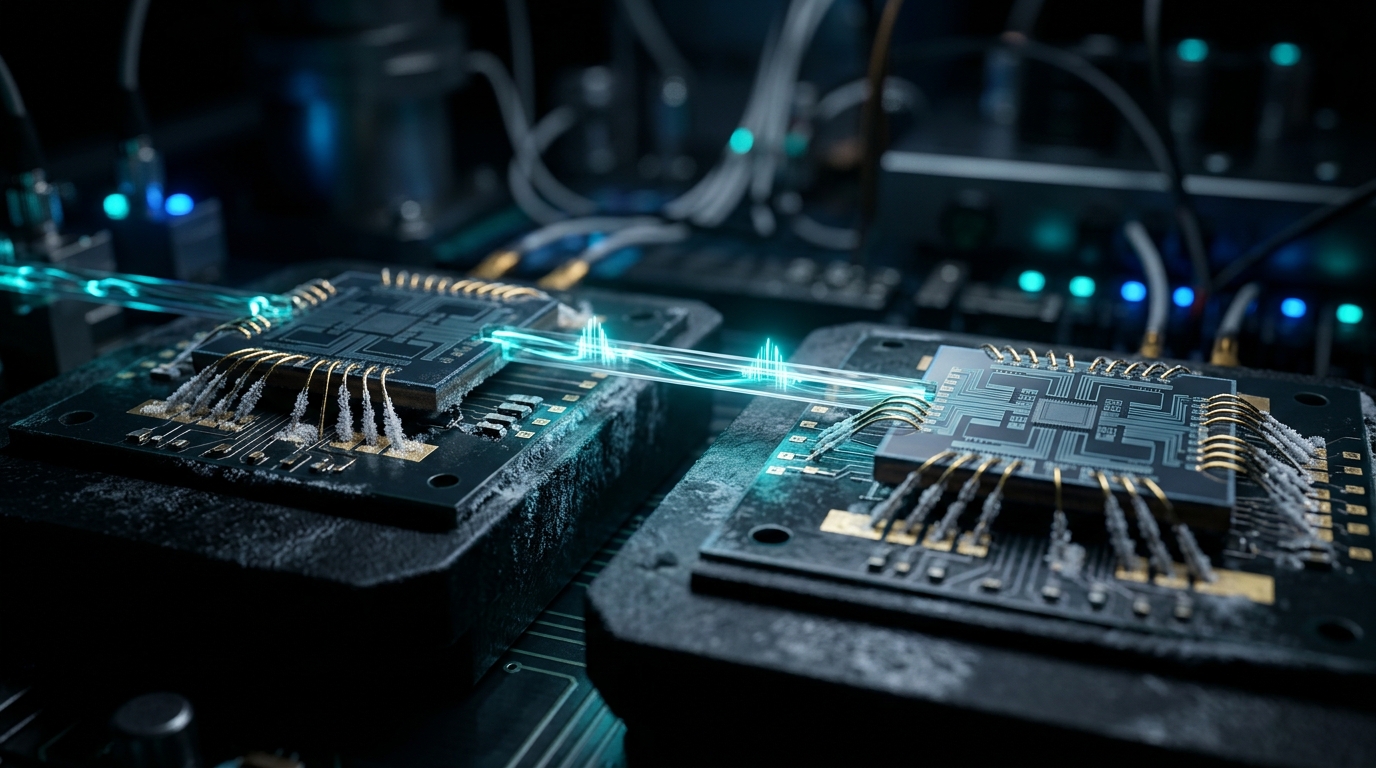
[IMAGE: Macro photograph of a three-layer superconducting quantum processor stack with vertically stacked chips connected by flip-chip bonds, illuminated by entangled cyan light beams against a deep black background, cinematic 8K quality with teal accent lighting highlighting the vertical coupler architecture]
The Architecture That Changes Your Migration Math
Picture your organization’s five-year PQC roadmap. It was built on an assumption: fault-tolerant quantum computers capable of running Shor’s algorithm at cryptographically relevant scales are at least a decade away. That assumption just got harder to defend.
A research team publishing under arXiv:2605.11488v1 demonstrated a 3D integrated superconducting quantum processor that vertically stacks two transmon qubit chips on opposing sides of a central carrier chip, connected via multilayer flip-chip bonding. The result is a three-layer architecture where intrachip coupling runs through planar tunable couplers and interchip coupling runs through vertical tunable couplers embedded in the carrier chip itself.
The fidelity numbers from randomized benchmarking are not incremental improvements. Single-qubit gates achieved 99.87% fidelity with negligible crosstalk. Controlled-Z gates — the two-qubit operations that matter most for quantum error correction — averaged 97.5% fidelity for both intrachip and interchip operations. The team then demonstrated high-fidelity Bell-state preparation and coherent generation of a four-qubit W state, confirming that interchip entanglement distribution works at these fidelity levels.
For CISOs tracking quantum threat timelines, the critical word in that last sentence is interchip. Achieving near-identical two-qubit gate fidelity across chip boundaries means the vertical stacking approach does not introduce a fidelity penalty at the seams — the exact problem that has historically made multi-chip quantum architectures impractical.
Why Monolithic Planar Architectures Hit a Wall
To understand why this matters, you need to understand the constraint it removes.
Conventional superconducting quantum processors are built as flat, monolithic chips. Every qubit, coupler, and control line competes for space on a single plane. As qubit counts grow, three problems compound: signal routing becomes geometrically intractable, crosstalk between neighboring qubits degrades fidelity, and the control electronics required per qubit cannot be physically routed to the chip edge at scale.
The research team states the problem directly:
“Scaling superconducting quantum processors beyond the constraints of monolithic planar architectures is essential for fault-tolerant quantum computation.”
Vertical integration — the same engineering principle that allowed semiconductor manufacturers to move from 2D NAND flash to 3D NAND — offers a path around this wall. By distributing qubits across stacked chips and using the carrier chip as an active coupling layer rather than passive substrate, the architecture decouples qubit count from planar real estate constraints.
The demonstrated architecture is explicitly described as compatible with advanced quantum error-correcting codes, which is the technical prerequisite for fault-tolerant operation.
Fidelity Numbers in Context: How Close Is “Close Enough”?
Fault-tolerant quantum computation requires physical gate fidelities above the error-correction threshold for the chosen code. For surface codes — the leading candidate for practical fault-tolerant processors — that threshold sits approximately at 99% for two-qubit gates, depending on the specific implementation.
The 97.5% controlled-Z fidelity demonstrated here sits below that threshold, but the trajectory matters as much as the current number. Two years ago, interchip two-qubit operations in multi-chip superconducting systems were achieving fidelities in the 94-96% range. Closing that gap to 97.5% while simultaneously demonstrating negligible crosstalk in simultaneous single-qubit operations represents a qualitative shift in what multi-chip architectures can deliver.
Comparison: Planar vs. 3D Integrated Superconducting Architectures
| Dimension | Monolithic Planar | 3D Integrated (arXiv:2605.11488v1) |
|---|---|---|
| Qubit scaling path | Limited by planar routing density | Vertical stacking decouples count from plane area |
| Single-qubit gate fidelity | Typically 99.5–99.9% | 99.87% with negligible crosstalk |
| Two-qubit gate fidelity (intrachip) | 97–99% (leading systems) | 97.5% average |
| Two-qubit gate fidelity (interchip) | Significant fidelity penalty historically | 97.5% — matches intrachip performance |
| Entanglement distribution across chips | Not demonstrated at high fidelity | Bell-state and 4-qubit W state confirmed |
| Error-correcting code compatibility | Architecture-dependent | Explicitly confirmed |
| Crosstalk under simultaneous operations | Increases with qubit density | Negligible at demonstrated scale |
The elimination of the interchip fidelity penalty is the architectural breakthrough. When two-qubit gate fidelity no longer degrades at chip boundaries, qubit count becomes a fabrication and engineering problem — not a fundamental physics constraint.
What the Data Gaps Tell You
The published abstract does not report total qubit count, coherence times (T1/T2), or fabrication yield data. These omissions matter for enterprise risk modeling. A processor with 99.87% single-qubit fidelity but T2 coherence times of 50 microseconds faces different practical constraints than one with 200-microsecond coherence. Organizations building threat timelines should weight this research as a strong architectural proof-of-concept, not a production-ready system specification.
Regulatory Timeline Pressure Is Already Real
NIST finalized its first three post-quantum cryptographic standards in August 2024: ML-KEM (CRYSTALS-Kyber), ML-DSA (CRYSTALS-Dilithium), and SLH-DSA (SPHINCS+). The U.S. Office of Management and Budget directed federal agencies to begin PQC migration planning immediately, with full migration of high-value assets targeted before 2035.
That 2035 horizon was calibrated against quantum hardware progress as understood in 2022-2023. The 3D integrated architecture demonstrated in arXiv:2605.11488v1 represents the kind of incremental-but-compounding progress that can shift expert consensus on timelines. When vertical stacking removes the primary scaling constraint and achieves near-threshold two-qubit fidelities simultaneously, the probability distribution for “when does a cryptographically relevant quantum computer exist” shifts left.
For enterprises in regulated industries — financial services under DORA, healthcare under HIPAA, defense contractors under CMMC — the compliance burden of a reactive migration is substantially higher than a planned one. A breach of RSA-encrypted data today, decrypted by a quantum computer in 2031 rather than 2035, does not reduce your liability. Harvest-now-decrypt-later attacks are already documented as an active threat vector.
Who Is Moving and Who Is Lagging
Google reported migrating Chrome’s TLS connections to hybrid classical/post-quantum key exchange (X25519Kyber768) in 2023, covering hundreds of millions of connections. Cloudflare enabled post-quantum key agreement across its network in 2022. Signal deployed PQXDH — a post-quantum extended Diffie-Hellman protocol — for key establishment in 2023.
The laggards are not small organizations. Enterprise PKI infrastructure, long-lived TLS certificates embedded in IoT devices, and blockchain systems using ECDSA signatures represent hundreds of billions of dollars in deployed cryptographic infrastructure that cannot be patched with a software update. The migration path for these systems is measured in years, not quarters.
The BeQuantum Perspective: Architecture Determines Urgency
At BeQuantum, we track quantum hardware progress specifically because it determines how much time our clients have — not as an abstract research interest, but as a direct input to migration urgency scoring in our PQC Layer.
The 3D integrated transmon result is significant for three reasons that don’t appear in the abstract. First, vertical tunable couplers are a modular primitive. Once the fabrication process for a three-layer stack is validated, extending to five or seven layers follows an engineering roadmap, not a new physics discovery. Second, the demonstrated interchip entanglement fidelity means that quantum error correction codes — which require high-fidelity operations across many physical qubits — can now be distributed across chip boundaries without prohibitive overhead. Third, the explicit compatibility claim with advanced error-correcting codes signals that the research team designed this architecture with fault-tolerant operation as the target, not just near-term noisy intermediate-scale quantum (NISQ) demonstrations.
For organizations using BeQuantum’s Digital Notary service for blockchain-anchored document verification, the relevant threat is not just to TLS — it is to the ECDSA signatures that underpin the verification chain itself. Our IceCase hardware security module already supports ML-DSA signing alongside ECDSA, enabling hybrid signature schemes that remain verifiable under both classical and post-quantum assumptions. That hybrid approach is the correct posture while migration is incomplete.
The question we ask every enterprise client is not “when will quantum computers break RSA?” It is: “how long does your migration take, and when do you need to start to finish before the threat materializes?” For most large enterprises, that answer is: you needed to start 18 months ago. The second-best time is now.
What Your Security Team Should Do in the Next 90 Days
Step 1: Audit your cryptographic inventory within 30 days. Map every system that uses RSA, ECDH, or ECDSA — TLS certificates, code-signing infrastructure, VPN configurations, API authentication tokens, and any blockchain-anchored verification systems. Tools like NIST’s National Cybersecurity Center of Excellence migration guides provide structured inventory frameworks. You cannot prioritize migration without knowing your attack surface.
Step 2: Classify assets by data longevity within 60 days. A TLS session protecting a web transaction has a short exposure window. An encrypted health record, a signed legal document, or a blockchain-anchored audit trail may need to remain confidential or verifiable for 10-20 years. Assets with long confidentiality requirements face harvest-now-decrypt-later risk today. Prioritize PQC migration for these assets first, regardless of where quantum hardware progress stands.
Step 3: Deploy hybrid key exchange on external-facing TLS within 90 days. ML-KEM (Kyber) is now supported in OpenSSL 3.x and BoringSSL. Enabling hybrid X25519+Kyber768 key exchange on your public-facing infrastructure requires configuration changes, not architectural redesign. This single step eliminates harvest-now-decrypt-later exposure for new sessions at near-zero operational cost. Test in staging, validate certificate chain compatibility, and roll out progressively.
Frequently Asked Questions
Q: Does the 97.5% controlled-Z gate fidelity demonstrated in this research mean quantum computers can already break RSA encryption?
A: No. Breaking RSA-2048 via Shor’s algorithm requires millions of physical qubits operating at fault-tolerant error rates, which demands two-qubit gate fidelities above approximately 99% sustained across the full computation. The 97.5% fidelity demonstrated here is significant architectural progress, but the demonstrated processor operates at a scale orders of magnitude below what cryptographic attacks require. The relevance is in the trajectory: this architecture removes the primary scaling constraint, which compresses the timeline to fault-tolerant operation.
Q: If NIST has already standardized PQC algorithms, why does quantum hardware progress still matter for my planning?
A: NIST standardization defines what algorithms to migrate to — it does not execute the migration for you. Enterprise PQC migrations typically take 3-7 years for organizations with complex PKI infrastructure, embedded systems, and third-party integrations. Quantum hardware progress determines how much of that window you have left. Faster hardware progress means less margin for slow migrations. The 3D integrated architecture described in arXiv:2605.11488v1 is evidence that the hardware roadmap is advancing faster than the 2022-era consensus assumed.
Q: Does this research affect blockchain security specifically?
A: Yes, directly. Most public blockchain networks — including Bitcoin and Ethereum — use ECDSA for transaction signing. A fault-tolerant quantum computer running Shor’s algorithm could derive private keys from public keys, enabling theft of funds from any address whose public key has been exposed on-chain. Blockchain systems face a harder migration problem than TLS because signature scheme changes require network-wide consensus upgrades, not unilateral configuration changes. Organizations using blockchain for audit trails, supply chain verification, or digital asset custody should treat PQC migration planning for these systems as a distinct, higher-complexity workstream.